
A Slice of Irish History and Legend
The idea for this itinerary came to me after my annual trip to see family and friends in Ireland in September 2025. I had visited some of the sites previously - Newgrange, Corlea Trackway, Trim, and Belvedere. I took the opportunity of mild weather to visit various sites in Counties Meath, Westmeath, Louth and Roscommon that spanned thousands of years of Irish history. From the Bronze Age megalithic sites at Rathcroghan to the medieval Old Mellifont Abbey to the Great Famine Museum at Strokestown House and the moving quiet of the Famine Graveyard outside Mullingar, (my home town and where my brother, Todd, still lives), I was stuck yet again by the remarkable span of history to be found across the Irish north Midlands and over the Shannon river.
As always, the dramatic nature of the backstories at each site, the knowledge of the expert docents in attendance, and how much each site spoke to a particularly interesting phase of Irish history moved me to imagine how I might combine these sites into an itinerary that would take you across 5,000 years of Irish history, and throw in a few legends along the way.
And so, below, I give you “A Slice of Irish History and Legend”, all to be seen in 8 days and within a few hours drive of Dublin, so you don’t have to spend too long in a tour bus!
On Day 1 after arriving in Ireland in the wee hours - overnight flights from the US arrive at about 5 am local time, though it will feel like midnight, EST! - you will have personal time to recover at the Davenport Hotel (https://www.davenporthotel.ie/?utm_source=googlelisting&utm_medium=organic), and then spend the afternoon sightseeing in central Dublin. I will be happy to provide suggestions on local sights, shopping and maybe even a local pub or two mentioned in Ulysses!
We will spend all of Day 2 in Dublin, taking a guided walking tour of Dublin history in the morning, and visiting the National Museum of Ireland (https://www.museum.ie/en-IE/Museums/Archaeology) in the afternoon. The latter is aimed to familiarize you with the important phases of Irish history, from the megalithic mounds of County Meath through the arrival of Christianity, the Vikings, the Normans, and the English.
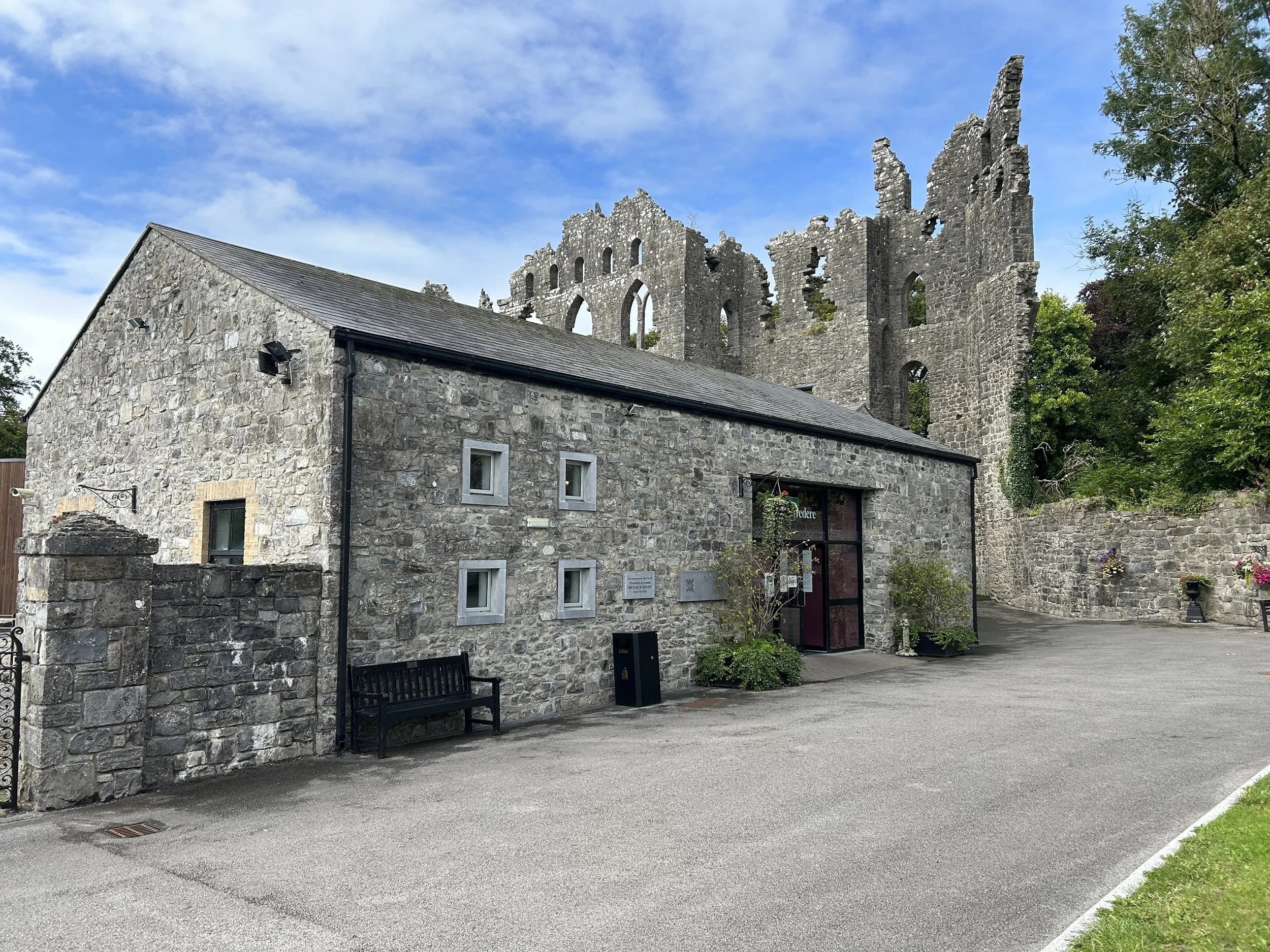
Day 3 will take us to County Westmeath to visit Belvedere House, on the shores of Lough Ennell in County Westmeath (https://belvedere-house.ie/). Belvedere is a stunning 18th century Georgian house with extensive gardens and the largest Gothic folly in Ireland (https://belvedere-house.ie/the-follies/).
After lunch, we will check in at nearby Bloomfield House Hotel (also on the shores of the lake).
In the afternoon we will visit Corlea Ancient Trackway (https://heritageireland.ie/places-to-visit/corlea-iron-age-roadway/), a 2,000-year old road discovered under the bog in nearby County Longford.
Outbuilding at Belvedere House, Co. Westmeath
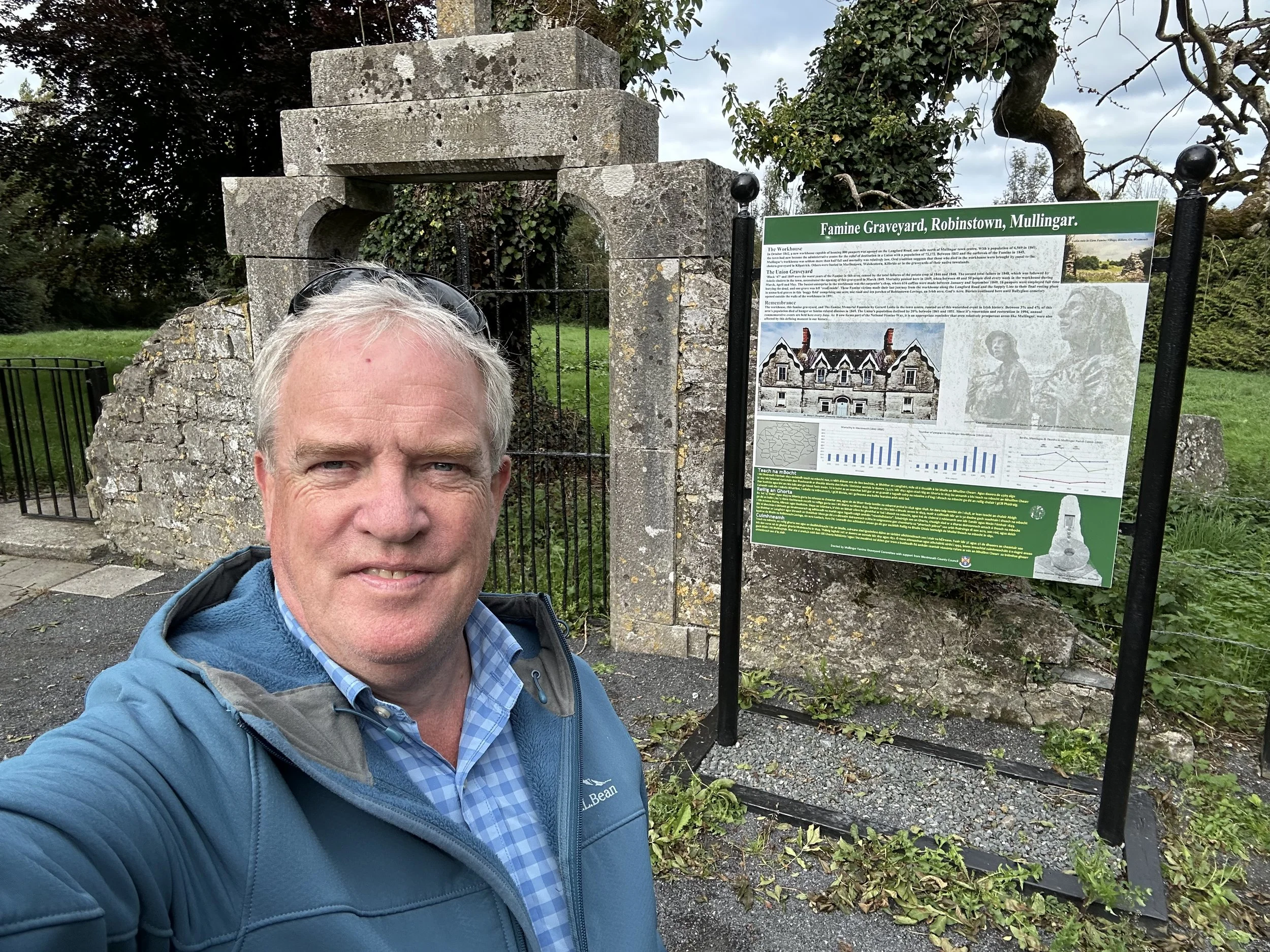
On the morning of Day 4, we will visit the small Famine Graveyard (https:// nationalfamineway.ie/mullingar-famine-graveyard/) outside Mullingar, a simple but moving testament to those who died in the nearby Mullingar Union Workhouse. Perhaps some who died there had trekked from Strokestown House in County Roscommon. That will be our next stop, along with its associated National Famine Museum. (https://strokestownpark.ie/ national-famine-museum/). The museum is located in what were outbuildings and stables of the “Big House”. The contrast between the landlords Big House and the plight of the starving Irish tenants could not be more striking.
Paul at Famine Graveyard, Co. Westmeath
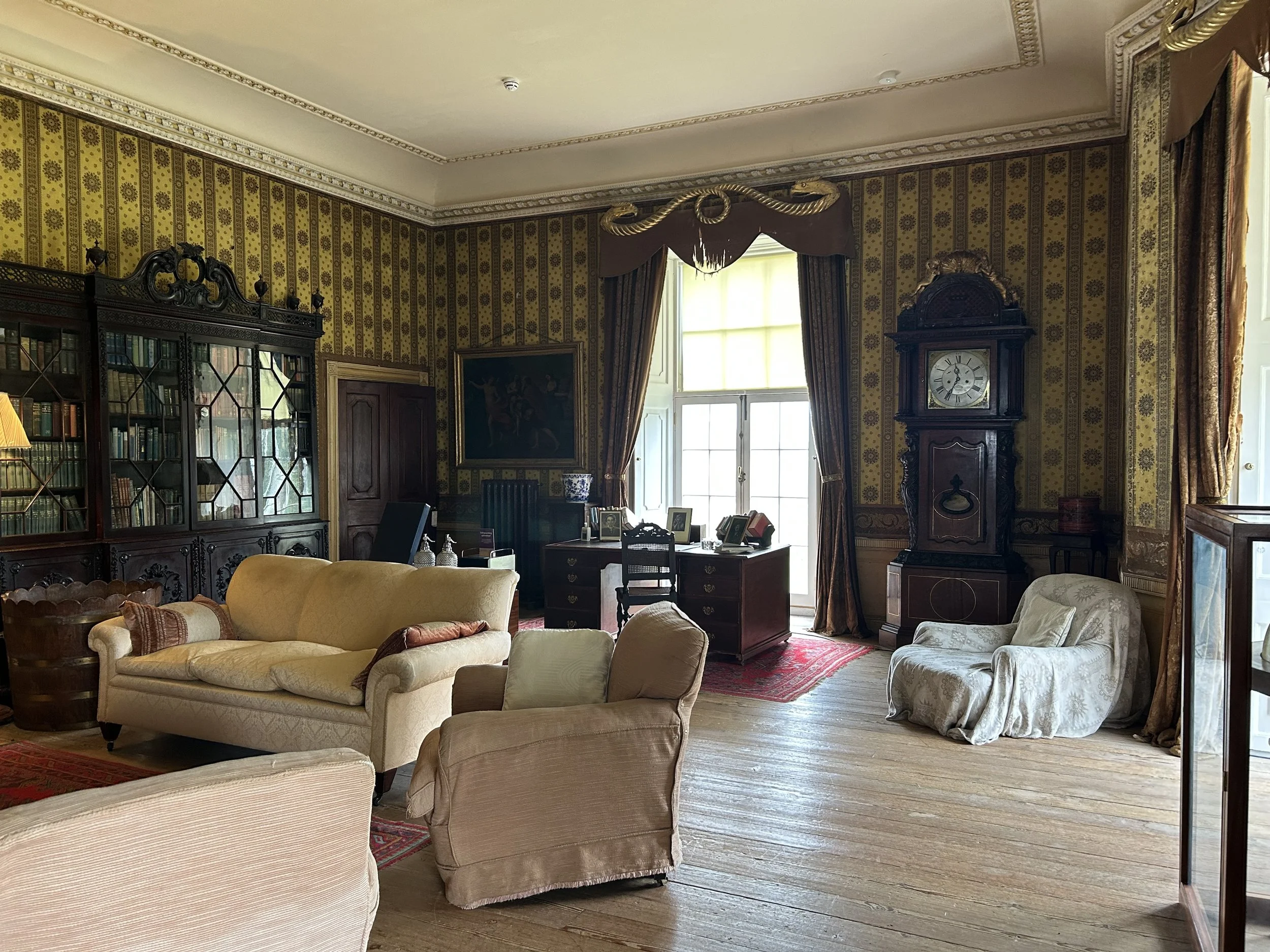
Strokestown House, Co. Roscommon
After lunch we will drive 20 miles further west to visit Rathcroghan Visitor Centre (https://www.rathcroghan.ie/) in the village of Tulsk. After reviewing the interpretative center, we will take to the fields to explore some of the over 240 archeological sites, including the legendary Owenyngat Cave (“the cave of the cats”), recorded by Christian scribes as a gate to the Otherworld. The area is the home of Queen Maeve, the legendary warrior queen of Connacht who launched the Cattle Raid of Cooley (the “Táin Bó Cúailnge”).
Day 5 will be spent exploring the archeology of County Meath. Specifically, one of the most dramatic man-made structures in Ireland or even Europe: Newgrange megalithic tomb (https:// www.newgrange.com/; also, featured in a New York Times Travel article in 2026: https://www.nytimes.com/2016/12/20/travel/ireland-newgrange-ancient-passage-tombs-mounds.html).
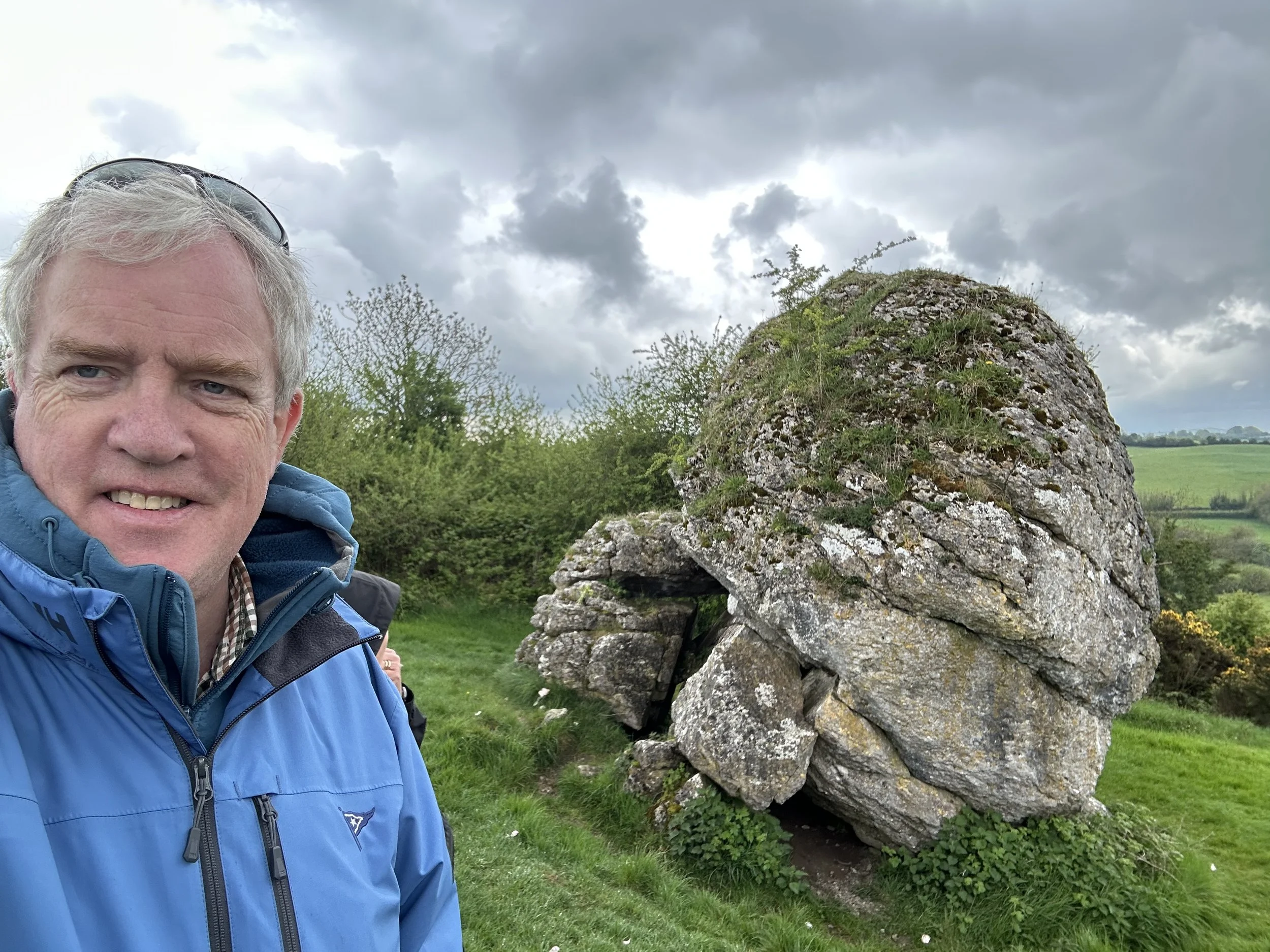
In the afternoon we will visit Sliabh na Caileach, the witches hill (“sliabh”, anglicized to “Slieve”, means hill in Gaelic - https:// voicesfromthedawn.com/loughcrew/ ). For those up to it, there is a gentle climb to the 900-foot summit. From there, you will have a wonderful view across County Meath and an opportunity to examine the burial mound that is thought to be at least 5,400 years old, part of the Loughcrew complex of ancient graves in the area.

Paul on Sliabh na Caileach, Co. Meath
On the morning of Day 6 we will visit the Hill of Uisneach (https://uisneach.ie/) on the outskirts of Mullingar, a prehistoric royal ceremonial site. After lunch at Fore Distillery and Barrell & Bean Cafe (https://www.foredistillery.ie/srsltid=AfmBOoqrlfVhP1ov3t8w2iEHgZjZfeYXFPhduuMO_8PTJdNXK6pNA1O5), we will explore nearby village of Fore (https://heritageireland.ie/places-to-visit/fore-abbey/) to see archeological sites including St Fechin’s Church (7th century), the Benedictine Priory (12th century) and the Anchorite’s (Hermit’s) Cell, a small tower and attached chapel, the latter being the crypt for the Nugent family of Clonyn Castle, Earls of Westmeath (not immediate relatives, as far as I know ;-)
On Day 7 we will visit the excellent example of a 12th century Norman castle (https://heritageireland.ie/places-to-visit/trim-castle/) in the town of Trim - where parts of the movie Braveheart were filmed (even if it was about a Scottish rebel!).
The afternoon will be spent at the (historically) more peaceful Old Mellifont Abbey, the ruins of a 13th century Cistercian abbey in County Louth (https://heritageireland.ie/places-to-visit/old-mellifont-cistercian-abbey-monastic-site/).
Paul on Hill of Uisneach, Co. Westmeath
View from Hill of Uisneach, Co. Westmeath
That evening we will return to Dublin, where on Day 8 you will have a free day to explore downtown Dublin and engage in some retail therapy. There are also several historically interesting locations worth visiting if you have not seen them previously: the General Post Office 1916 Museum (https://www.gpomuseum.ie/), ground zero for the events of Easter Week 1916 that set in motion the final push for Irish independence; the EPIC Emigration Museum (https://epicchq.com/) on the banks of the River Liffey, where you will get a sense of the extent of emigration from Ireland over the past several hundred years, and better understand why 30-40 million Americans can claim some Irish ancestry; and 14 Henrietta Street House Museum (https://14henriettastreet.ie/). Also, I will be available to advise on other sights.
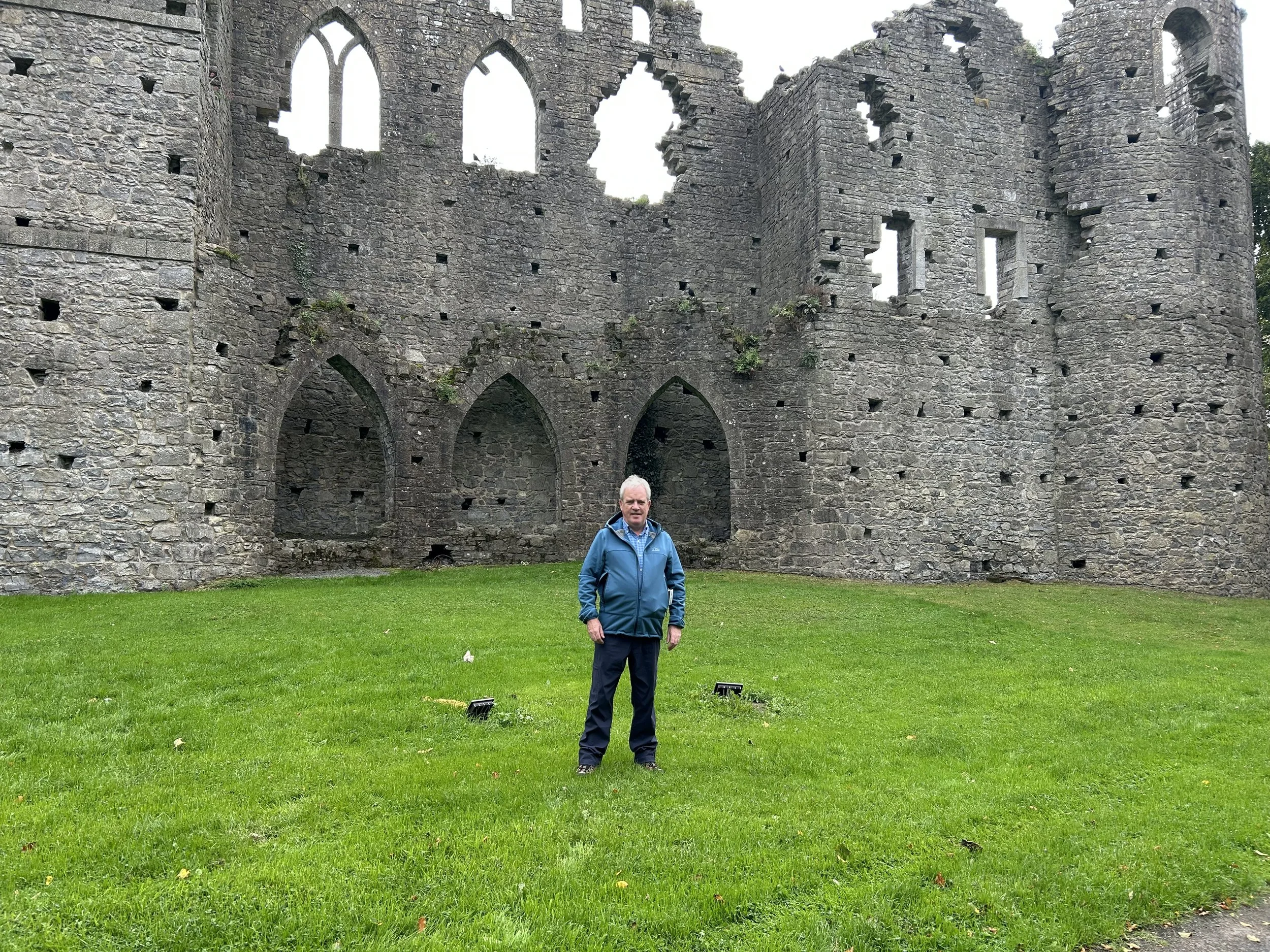
Paul at Gothic Folly at Belvedere House, Co. Westmeath
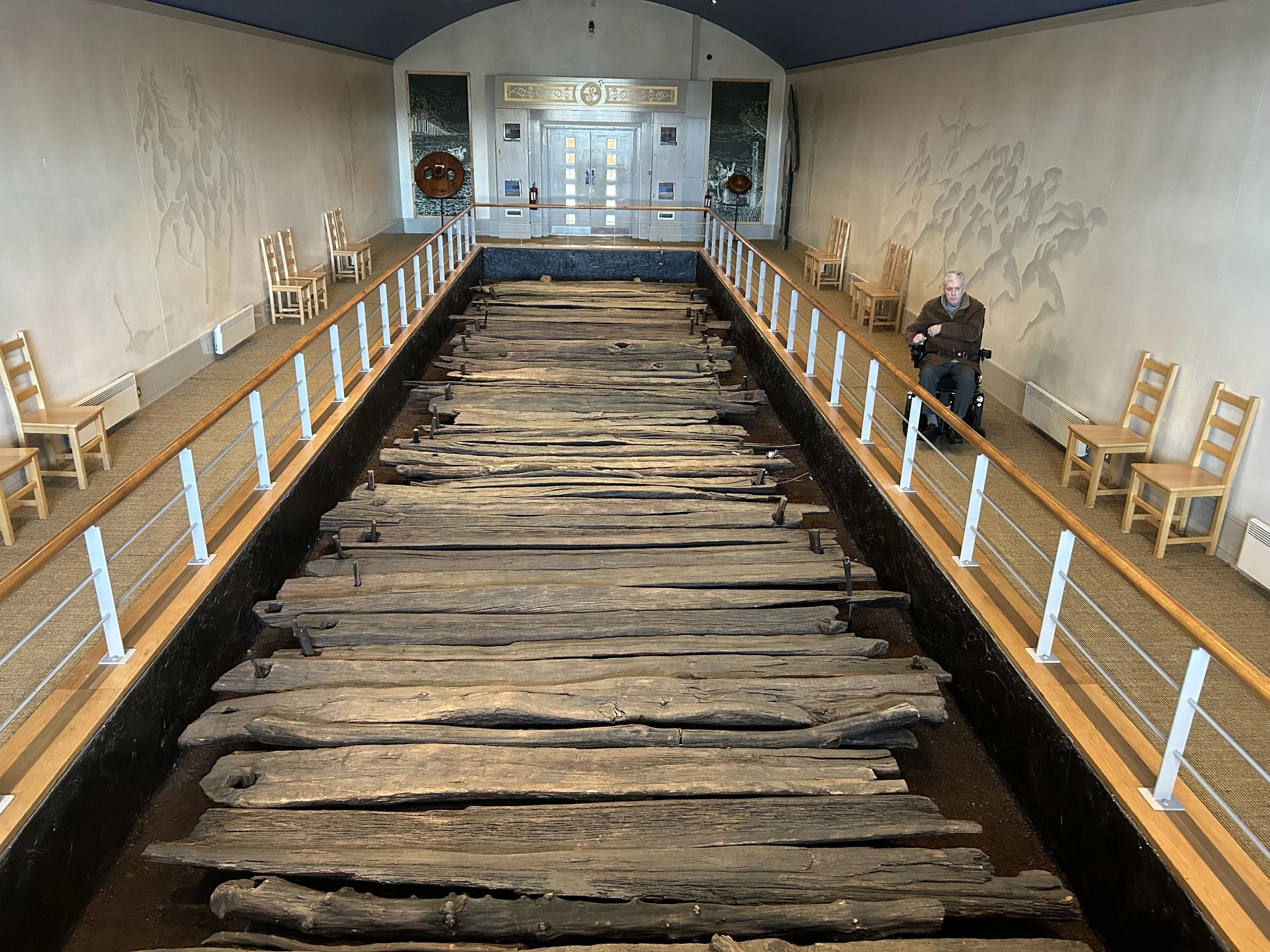
Corlea Trackway, Co. Longford
In the evening we will celebrate our trip with a farewell dinner at the Trocadero Restaurant (https://www.irishtimes.com/food/restaurants/review/2025/03/27/trocadero-restaurant-review-a-timeless-classic-that-is-old-school-in-the-best-sense-2/), just off Grafton Street in the city center (and walking distance to our hotel).
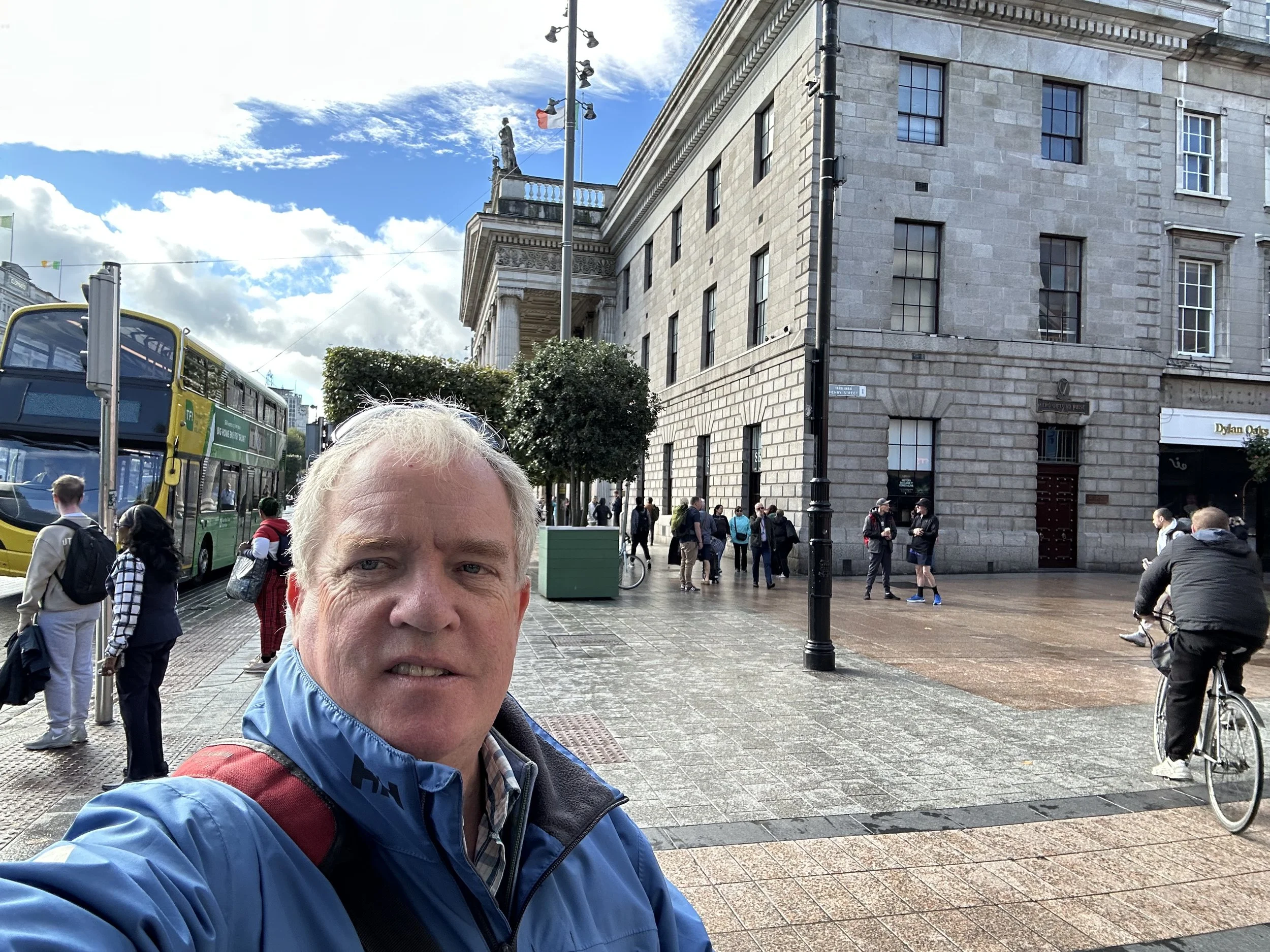
Paul in front of GPO, Dublin.